Thursday, May 5, 2016

Terrific Toys - The Game of Things... humor in a box


I came across this game in Target, and the open-ended-ness of the game intrigued me. So, I tried it out on my family during our two-day drive to the Grand Canyon. 

Well, I don't know what I expected, but it was fun! And a lot of the questions were very thought provoking and triggered all kinds of side conversations. This game kept us engaged for several hours (and the fact that the driver could easily participate was a definite plus). 

I'm not sure if I'd put this game at the level of Monopoly Deal, but it has its own charms. Though we weren't playing by the rules (we needed more than four people to play by the game's rules), I thought it did a great job of getting to know each other better (and I thought I already knew my family very well, but there were surprises).

Wednesday, May 4, 2016

Bridge Building Series - Beam Bridge 2

Now that we understand the basics, let's go on to a more complicated beam bridge project.

We’ll make a beam bridge in this section using straws and tape.

Design Rules for the bridge:
1.      Bridge must span 12 inches.
2.      Bridge must have a place to attach a small cup in the center of the span (preferred).

Supplies:
·         A bag/box of straws
·         Tape
·         Scissors
·         Small cups (or wedding favor mini buckets from the Dollar Tree stores)
·         Paper clips
·         Weights – pennies, paper clips, etc. Anything is OK as long as they weigh the same. You want to compare how much different bridge designs can support
    
Instructions:
1.   Take 6 straws and cut off all the bendy parts, if you have bendy straws.
2.   On one end, pull a straw 1 1/2 inch up between two straws and tape them together.
3.   On the other end, tape together the two straws without anything in between them. This should result in a triangular shaped support structure for your beam bridge. 


5.   Repeat steps 3 and 4 and make the second support structure.
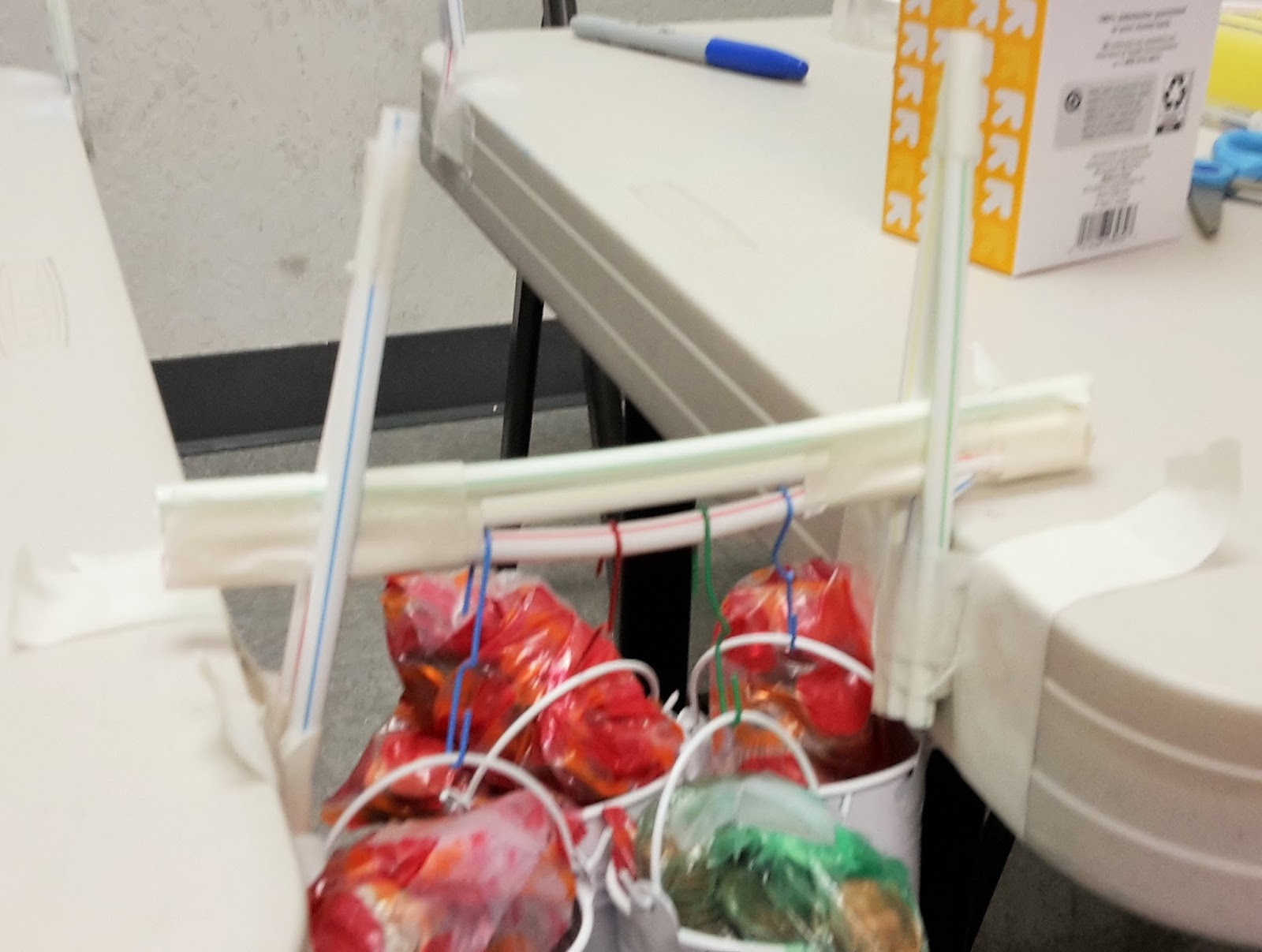
6.   Tape the wide ends of the support structure to tables, chairs, desks, etc. that are 12 inches apart.
7.   Place a straw between the support towers.


8.   Hang a small cup in the middle of the bridge (use hole puncher and paper clips) and load it with pennies, paper clips, etc. to weigh it down and test its strength.


I've done this project with my students, and I was blown away by how much a bridge like this could hold.

This bridge has 3 reinforced beams, but the beams themselves are neither taped to the table nor the support structure.

This is a variation on the beam bridge with side supports and 3 reinforced beams.

This bridges is made of 3 reinforced beams, but without any other special features.

My students' beam bridges held up to 500 pennies with their specially designed beam bridges.

Do you think you can beat that? I bet you can. I thought this type of bridge could hold up to ~200 pennies, at the most. Boy, was I wrong!

I hope you have a lot of fun with this project.


Tuesday, May 3, 2016

Awesome Books - A Smart Girl's Guide - Boys By American Girl Company


We were at Barnes and Noble the other day when I came across this little gem of a book. Though the title says a smart girl's guide to Boys, I bought it for both of my children, and I discovered it's a great book for introducing a lot of not-so-comfortable issues to both genders. 


As you can see, this book covers a lot of topics with a good balance of thought provoking questions to sprinkles of humor and confidence boosters.

My son read it, and he thought it was pretty good in providing insight into what girls might be thinking. And when my daughter's old enough, I'm going to have her read it to try to understand boys.

Because it was from the American Girl brand, I didn't expect too much, but I was very surprised at what great advice this book gave to girls.

I would recommend this book to all girls and maybe some boys.


Monday, May 2, 2016

Bridge Building Series - Beam Bridge 1

Before we go on to the topic of beam bridges, I'd like to discuss the type of forces acting on a bridge. 

At any given time, two types of forces act on a bridge: compressive force (compression) and tensile force (tension).

The compressive force is a force that compresses or shortens the thing it is acting on. The tensile force is a force that expands or lengthens the section it is acting on.

Beam Bridges

These bridges are everywhere.

They are the simplest and least expensive bridges to build. 

When a load is placed on the beam bridge, the top of the beam bridge is pushed down by a compressive force as a tensile force stretches the lower portion of the beam bridge. The farther apart the supports structures are, the weaker a beam bridge becomes. 

A simple beam bridge experiment

Supplies:
·         A sponge 
·         A permanent marker
·         A ruler
·         2 books (or anything that can create a gap to lay a sponge across)

 Build instructions:
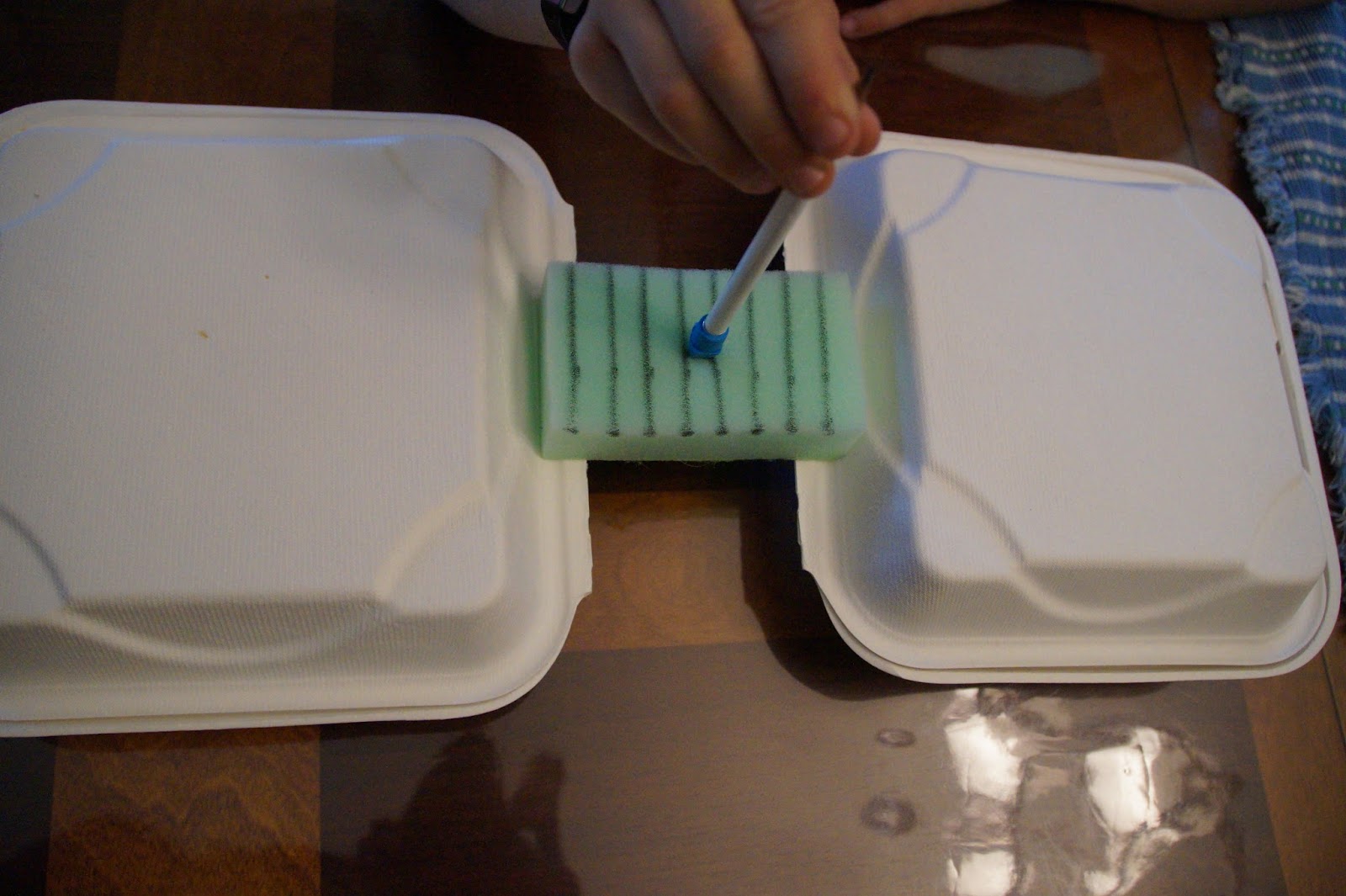
1.   Draw lines 1/2” apart on the sponge.
2.   Lay it across a gap created by books, desks, or other flat objects.
3.   Tape/secure the ends onto the books, desks, or other objects.
4.   Now, press down on any part of the sponge. What happened? Do the lines curve inward and closer or curve outward and farther on top of the bridge? How about the bottom of the bridge?

Top View


The 1/2" gap between the two lines is beginning to close in and shorten.

The 1/2" gap between the two lines is closing and is shortened noticeably compared to the gap between the other lines.

The 1/2" gap between the two lines is invisible. It looks as if the two lines are one.


Bottom View

The 1/2" gap between the two center lines is just beginning to lengthen.

The 1/2" gap between the two center lines is lengthening more.

The 1/2" gap between the two center lines has expanded and lengthened.

Our bridge has collapsed due to too much load on the bridge.

I never thought to do this simple experiment because it seemed so...simple. But it easily and clearly demonstrates tensile and compressive forces acting on a bridge. 

This simple understanding will lay the foundation for the bridge experiments to come.

Have a great day!

Thursday, April 28, 2016

Building Bridges Series - Introduction

I’ve conducted hundreds of hands-on Science projects at an elementary school in my neighborhood for many years, and I’ve learned something important. Though the students enjoyed the hands-on experiments, the projects were more meaningful to them when I gave them context.

So, as we embark on this bridge-building adventure, I'll provide an overall context for the experiments in this book.

One of my primary goals for starting this companion blog, as I write a bridge project book, is to make STEM projects loaded with learning opportunities very affordable, even for a classroom set. 

As I noted before, I purchase most of my supplies from the Dollar stores, Target, etc. I hope this affordability will enable parents and teachers to make use of my experiments more in their homes and classrooms.

A short summary of the history of bridge building

Humans first made bridges using wooden logs, planks and lashing together sticks, bamboo poles, and tree branches. Eventually, humans started building bridges with stones, and one of the oldest bridges still in use was a stone arch bridge in Greece dating back to the Greek Bronze Age (13th century BCE).

The Romans were the greatest bridge builders in ancient times. The Roman built arch bridges that withstood extreme conditions, which would have damaged earlier bridge designs. The Romans also used cement, which lessened the changes in strength from stone to stone.

Many innovations took place in the bridge design during the 18th century from timber bridges to iron bridges. Following the Industrial Revolution in the 19th century, truss bridges were designed to carry larger loads (larger bridges, more freight, and people). But wrought iron didn't have enough tensile strength to meet the demands for ever bigger bridges. Later, much larger bridges were built with steel and their designs were influenced by Gustave Eiffel's ideas.

Nowadays, three basic types of bridges are used in transportation. They are beam and truss bridges, arch bridges, and suspension bridges.


Saturday, October 24, 2015

Tech Challenge Update - 10/24/15

It's that time of the year, again. The start of another Tech Challenge at the Tech Museum of San Jose.


This year's challenge is... (from the website)
http://www.thetech.org/tech-challenge-presented-emc

The 2016 challenge: Build a glider to deliver supplies to a remote location!
This year, you tell the story! What is your glider carrying? Where are you going? Why?

New award for 2016: Top Tech Challenge story! 
Who: Students in Grades 4-12
What: A team engineering design challenge
When: Event Days are Saturday, April 23 (Grades 4-6) and Sunday, April 24 (Grades 9-12 and Grades 7-8)
Why: To develop creative solutions to a real-world problem

Please check out the challenge and join in on the fun.

I think this is one of the best STEM programs out there, and kids learn so much from the process. Not about STEM, but about very important life lessons such as perseverance, teamwork, problem-solving, leadership, and dealing with multiple, repeated failure.

Sure, it seems like a lot of time commitment, but our teams have spent between 36 - 57 hours (that's from October to April) and attended 3 - 5 test trials in the last three years.

But how much time you spend with your team depends on your team's schedule and availability. I've known teams that attend every test trial each year, and other teams that barely attend one. There is no correct formula to experience this wonderful learning process.

Have a great day.

Saturday, September 26, 2015

an update

Hello everyone,

I've been dealing with an urgent family medical issue that ended up becoming a long-term care event since mid-July, and I haven't had the time to pay attention to this blog. My plan is to get back to this blog sometime soon. 

In the meantime, I've created a t-shirt design to encourage kids to embrace Science. I see so many cute t-shirts about playing video games, not wanting to do homework, etc., but not much for encouraging Science or anything else remotely academic for that matter.

Please check out the link below.


Have a great weekend.