Showing posts with label paper. Show all posts

Monday, January 29, 2018

Take the 2018 Fluor Engineering Challenge!

I became aware of this competition a little over a year ago (2017 challenge, which was different from this one) when I was perusing the sciencebuddies.com site. I thought it was interesting and tried it with my daughter's class along with a few other classes.

Though the teachers and I were concerned about spilling water in class on the carpet (yes, last year's project involved a tub of water), it wasn’t too bad. And the project was great! The students learned a lot, but more importantly, they had fun figuring things out for themselves.

Year after year, this Flour Engineering Challenge is just plain fun. But best of all, it gives your children opportunities to win money for their school.

2018 Fluor Engineering Challenge


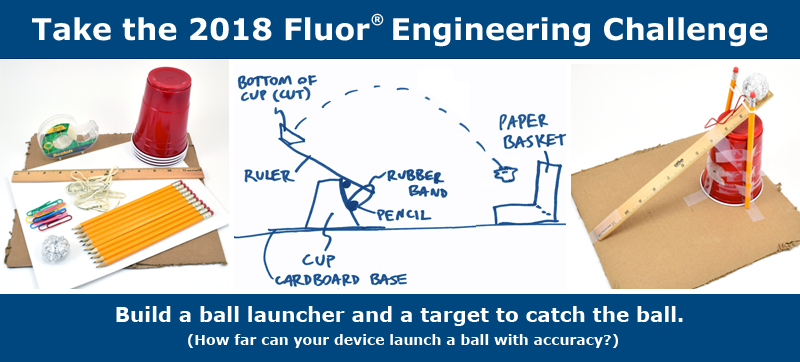
The objective of the 2018 Fluor Engineering Challenge is to use limited materials to build one device (the launcher) that launches an aluminum foil ball and another device (the receiver) that catches the ball. The farther your ball flies before being successfully caught by the receiver, the more points you get. 

Your children can use only a limited list of materials, and there are points associated with each item. The less material your children use, the more points they keep.

List of Materials (see website for more detail description):
Corrugated cardboard base
Large paper or plastic cups
Wooden rulers
Paper
Wooden pencils
Rubber bands
Large paper clips
Roll of adhesive tape

2018 Flour Engineering Challenge Website

Challenge objective & info

In mid-February, I’m planning to do this project at a local elementary school. I’ll share the results with you afterwards.


Have fun!

Monday, June 12, 2017

Balloon Rocket Cars

I am always looking for an easy project I can do in a classroom of 30+ kids. If I can quickly put kits together, that's great, but many projects, especially when preparing for 30+ kits, take a lot of work and time. So, when I found a kit for this project for $1.20/kit, I jumped on it and bought 4 sets of 10 kits. But I realized that I could probably put a kit together cheaply with every day materials.
Putting the vehicle together took matter of minutes, which was great since I only had an hour for the project. Then they were asked to power it by attaching a balloon to it. They were given a choice of two different sized balloons as well as complete freedom to shape and attach the straws whichever way the students wanted to try. I like to tweak things a bit, forcing the students to figure things out on their own.
The students had a fantastic time trying out different weights, sizes, attachments and learned while having fun. Unfortunately, we didn't have enough time to try out the incline surfaces and frictional losses. But, I'm looking to continuing with it during next school year.
I hope you’ll have fun with this project!

SUPPLIES:

For Vehicle:
  • 1 Corrugated plastic or cardboard piece for the vehicle body (3 in x 5 in)
  • 2 Plastic coffee stirrers
  • 1 Plastic drinking straw, cut in two equal pieces
  • 4 Foam disks for the wheels (~ 2.5 in in diameter and 0.5 in thick), but if you can't find these, you can cut them out from the same corrugated cardboard
  • Tape
For Rocket Balloon Power:
  • 1 Plastic drinking straw
  • 1 Balloon any size, but I took balloons of various sizes to the classroom to show the students the difference in air-power (also, to show them that BIGGER isn't always BETTER)

INSTRUCTIONS:


  • I used a delivery cardboard box to cut out my vehicle chassis (3 inches x 5 inches).
I was able to cut out several fairly easily and quickly. But I'm not sure I'd be up for cutting out 30+ sets x up to 12 classrooms. So, I would probably buy the kits, if I could still find them for $1.20/kit.
  • Cut a drinking straw in half.
If you have a bendy straw, cut off the bendy part first. Then cut the rest of the straw into two equal pieces.
  • Tape the cut pieces of straw on to the both narrow sides of the vehicle chassis, centering it across the width.

  • Insert one end of the coffee stirrer into one of the foam disks.


  • Insert the coffee stirrer with a wheel attached already through the already taped drinking straw on the vehicle chassis.
  • Insert another wheel on the remaining end of the coffee stirrer.

  • Do the same for the other side.

  • Cut a drinking straw to your desired length.
If you have a bendy straw, you can decide what to do with the bendy part. Then cut the straw to the length you want. It's up to you to decide which length works for your design.
  • Insert a straw into a balloon.
  • Put a rubber band around the neck of the balloon over the straw.
DO NOT tie the rubber band too tight. It can collapse the straw, and it won't work well (I've learned from experience).


I decided to create two different designs to see if there's a difference in the distance the vehicle traveled.
  • The 1st balloon rocket design has a straight straw piece inserted in the balloon.
  • The 2nd balloon rocket design has a bendy straw piece inserted in the balloon.
The 1st balloon rocket design traveled farther with the vehicle than the 2nd.
NOTE: I tried 2nd balloon rocket design with the bendy part up and down, and both positions had problems. Why don't you try it and see what it does?
PROBLEM SOLVING:
  • As soon as the students started testing their balloon rocket cars, they complained about the wheels coming off completely or their cars curving to the right or the left. I challenged them to come up with a solution to their problem.
Many started with taping the ends of their axel to stop the wheels from coming off, but it didn't stop the wheels from wobbling and not going straight (which was one of the requirements of the project).
  • Some complained that their vehicles refused to move, even with a gigantic balloon attached to it.
They had taped the axel (the coffee stirrer) to the axel housing (cut drinking straw), and it couldn't rotate. Therefore, the wheels couldn't rotate, which prevented the vehicles from moving.
  • Some students did blow gigantic balloons and learned that BIGGER isn't always BETTER.
Though the vehicles started fast, but they turned upside-down or rolled to one side due to the balloon rocket being too powerful for the vehicle. We tried to weigh down the vehicle, but it didn't work very well.
ADDITIONAL PROJECT IDEA 1:
This is part 1 of the add-on project I didn't get to do with the class.
  • Measure how far a vehicle will travel on flat surface.

  • Ramp 1 - Measure how far the same vehicle will travel on this inclined surface.
The plastic tub is 6 inches high, and the ramp is 22 inches long.
  • Ramp 2 - Measure how far the same vehicle will travel on this inclined surface.
The plastic tub stack (2 tubs) are 12 inches high, and the ramp is 22 inches long. The steeper descent made the vehicle more unstable, and it crashed into the nearby wall.
ADDITIONAL PROJECT IDEA 2:
This is part 2 of the add-on project I didn't get to do with the class.
  • Measure how far a vehicle with travel on flat surface (see project idea 1).

  • Measure how far the same vehicle will travel on carpet.
NOTE: The car on the carpet will not travel as far as the car on the smooth surface. The difference in the distance traveled is the force lost due to friction.
SCIENCE BEHIND THIS PROJECT:
I love Newton's Second Law, because it's easy for people to understand.
Force = Mass x Acceleration.
I use this all the time when I do projects with students. Whether it's a kindergarten class or a sixth-grade class, I write F = ma on the whiteboard and explain the relationship between them.
On flat surface (1st diagram): F = ma = F (Balloon) - F (Ground friction)

  • The total of all the forces acting on our vehicle will result in acceleration.
  • How fast the vehicle will accelerate will depend on the size of the force acting on the vehicle.
  • When the air in the balloon is pushed out of the straw through the back, the balloon is pushed forward. When the balloon is pushed forward and is taped to the vehicle, the vehicle moves forward with the balloon.
Actually, F=ma is too simple. What it really means is that F = ma = F (Balloon) - F (Ground friction). But in most cases, we assume F (Ground friction/Resistance) = 0 on smooth surfaces because it's very, very small.
On a ramp (2nd diagram): F = ma = [F(Normal) - F(GravityY)] + [F(Balloon) + F(GravityX) - F(Ground friction)]

  • The total of all the forces acting on our vehicle will result in acceleration.
  • How fast the vehicle will accelerate will depend on the size of the force acting on the vehicle.
  • When the air in the balloon is pushed out of the straw through the back, the balloon is pushed forward. When the balloon is pushed forward and is taped to the vehicle, the vehicle moves forward with the balloon.
If the ramp is smooth, F (Ground friction) = 0, too. F (Ground friction) depends the smoothness of the surfaces, not the angle of inclination. And conveniently, [F(Normal) - F(GravityY)] = 0, because they are equal and opposite forces.
So, the long equation is shortened to F = ma = [F(Balloon) + F(GravityX)].
NOTE 1:
In kindergarten, I use addition/subtraction to get them to understand the relationship between the three. If F is constant, and m is big, a is little and vice versa.
NOTE 2:
If you want to solve for F(GravityX), the mathematical equation is
F(GravityX) = F(Gravity) x sine(angle).
If you want to solve for F(GravityY), the mathematical equation is
F(GravityY) = F(Gravity) x cosine(angle).
NOTE 3:
In More Air-Powered 2, Frictional Forces, F(Ground Friction) is not 0.
The car on the carpet will not travel as far as the car on the smooth surface.
The difference in the distance traveled is the force lost due to friction.
Tuesday, May 10, 2016

Bridge Building Series - Arch Bridge

Arch Bridges

Arch bridges have extraordinary strength due to their shape.


Unlike a beam bridge, the weight and the load on an arch bridge are pushed outward and carried along the curve to the support structures at each end called abutments.

An arch bridge carries all loads in compression, without any tensile forces. The stones in an arch bridge stay together by the force of their weight and the compressive force transferred between them. 

The size of the arch directly affects the effectiveness of an arch bridge. The arch is flattened down in very large arch bridges and large tensile forces that must be factored into the bridge design.


A simple arch bridge experiment

Supplies:
·         A ¼ piece of cardstock paper
·         A permanent marker
·         A ruler
·         A stack of books to wedge in the paper

Building instructions:
1.   Draw lines 1/2” apart on the cardboard or cardstock paper. 
2.   Wedge it between a gap created by books, chairs, desks, or other objects.
3.   Tape the ends onto the books, desks, or other objects.
4.   Now, press down on any part of the arched cardboard or cardstock paper. What happened? What is happening with the lines on the cardboard?

Top View

An arch bridge without an additional load.

An arch bridge with some load. It still holds its shape well.

An arch bridge with considerable load. It still holds its shape pretty well.

An arch bridge in danger of collapsing. The arch has flattened out too much.

Bottom View
An arch bridge with very little load. It holds its shape well.

An arch bridge with more load. It holds its shape well, again.

An arch bridge under considerable load. Its arch is beginning to flatten out a bit.

An arch bridge in danger of collapsing. The arch has flattened out too much.
Again, this is a very simple project, but it does an excellent job of demonstrating what an arch bridge experiences under load.


Monday, July 13, 2015

Air-powered vehicle, Part 2 - How to make a vehicle

Two years ago, I spent 26+ hours prepping a rubber band drag racer for a 4th grade class science project (my guinea pig class), and it was a complete BUST! Even after I worked out the kinks, unforeseen issues came up and things didn't go smoothly. After spending 1 1/2 hours in class, kids were very disappointed with the result (imagine my frustration!). 

After that project, I have a general rule of spending two to three hours to try it out, and if it doesn't work, I go on to another. Well, this one, I tried building a prototype with my daughter, and it went very well. I'm definitely going to use this project in the classroom this fall.


Prototype my daughter and I built the other day.
 As I said before, there are books/kits combo for this project on sale online, but it was cost-prohibitive for me. So, I came up with a more affordable alternative.

Supplies Needed:


  • Balloon
  • Rubber bands
  • Straws
  • Thin bamboo chopsticks (skewers, lollipop stick, etc. will work, too)
  • Ruler
  • Scotch tape
  • Masking tape
  • ~2" diameter circle maker
  • A piece of cardstock paper
  • Small screwdriver or awl
  • Something to cut chopsticks
  • Scissors
Project Instructions:
  • Step 1 - Tape together the two boxes from the Part 1 of this project and set them aside.


  • Step 2 - Trace and cut out the Six wheels with the holes for the axle in the center.


  • Step 3 - Mark and cut three axle casings to size (~1/2" wider than the vehicle body width). An axle should freely slide in the casing. 

  • Step 4 - Mark and cut three axles to size (~ 1" to 1 1/2" wider than the axle casing width). An axle should slide freely in the casing.


  • Step 5 - Assembling the "engine" of this vehicle.
  • Insert a straw into a balloon.
  • Put a rubber band around the neck of the balloon over the straw.
DO NOT tie the rubber band too tight. It can collapse the straw, and it won't work well (I've learned from experience). The bendy-side of the straw should be outside to direct the air flow.

  • Step 6 - Tape the axle casings on the bottom of the vehicle. Place rubber bands on the boxes. The orange box is the front-end of the vehicle, and the green box is the back-end of the vehicle. This rubber band configuration worked for me, but you can try others to keep the balloon and the straw in place.
  • Step 7 - Put the wheels on the axle. Surprisingly, this was the most difficult part of the project - sticking/taping/sliding wheels onto the axle. I wasn't satisfied with any of the processes of keeping the wheels on the axle, but all three ways work.
  • Step 8 - Affix balloon and straw on the top of the vehicle.
  • Step 9 - Blow the balloon and have a race!
Need a picture

In the process of building this vehicle for the blog and instructables.com, I built three.


I found it challenging to make the vehicle go straight. There were a lot of variables to consider, but the most important one is to make sure that the axle casing is taped on straight. Also, try tweaking the axle and flattening out or smoothing out wheels, but the results were mixed. I may have to tinker with this a little longer.

This project was a surprise because I expected it to take longer. But it didn't, and I was really happy with that. I could have cut out even more time by using a single serve cereal boxes or other smaller movie-sized candy boxes, but as I said, I wanted uniformity of sorts. But I'm not sure if I'm going to stick with making the boxes in classrooms because I only have 1 or 1 1/2 hours per project.


Thanks and have fun!