Showing posts with label Eyes. Show all posts

Monday, February 19, 2018

Attaining Invisibility!

Did you ever wish you had Harry Potter's Invisibility cloak? 
I certainly did when I read the books and watched the movies. 
So, do you think you can be invisible? 
It all depends....

Our eyes...

First, let's talk about how we see (how things become visible to us).


Some facts about how we see:
  • Light rays are reflected from a surface in straight lines. 
  • When light rays hit a smooth surface, the light rays are reflected back at you.
  • When those light rays enter our eyes and hit our retinas, an image is formed (upside down)
  • When light rays hit an uneven surface, the light rays are scattered. The reflected light bounces off in all directions, unable to form a coherent image.

Do you see the light colored blob in the bottom of her eye? That's me, reflected in her eye. Isn't it amazing?

So, how do we achieve invisibility in Real Life? 

How about a stealth fighter plane/helicopter/ship?
  • As the radar antenna turns, it emits extremely short bursts of radio waves, called pulses. The pulses move through the atmosphere almost at the speed of light. By recording the direction in which the antenna was pointed, the direction of the target is known. The better the target is at reflecting radio waves, the better it will be able to attain invisibility.
  • Stealth technology cannot make the aircraft invisible to enemy or friendly radar. All it can do is to reduce the detection range of an aircraft. This is similar to the camouflage tactics used by soldiers in jungle warfare. Unless the soldier comes near you, you can't see him.
  • Reduce radar cross section
  • Change vehicle shape to reflect radio waves in all directions
  • Use new technology to absorb/trap radar waves
  • Use of non-metallic airframe
A simple experiment on invisibility

For this experiment, you'll need large piece of foil (large enough to see your face in). 
  • Be careful to cut/tear that piece of foil without crinkling it at all.
  • Smooth it out (don't touch it too much) and look at yourself in the foil. Sure. It's not like a mirror, but you should be able to make out your facial features.
  • Now, crumple that sheet of foil into a fist-sized ball.
  • Then, open it up and smooth it out as well as you can.
Now, can you see yourself in the foil? You can't. So, why do you think you can't see yourself at all in the same sheet of foil?

When the foil is scrunchy and rough, the reflected light bounces off in all directions. And because these reflected rays are going off in all directions, your face does not form in the way it did before.
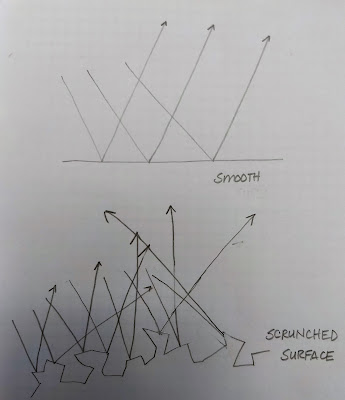


This is a very simple experiment, but there's a lot to learn from it. For deeper learning, search for pictures of stealth planes, stealth helicopters, stealth ships, etc. There are a lot of angles on the vehicles. Not smooth like the traditional vehicles.

Have fun and enjoy the day!

Thursday, March 12, 2015

Eerie Eye Tricks - March 12, 2015

This project is probably more appropriate for primary grades. I do have another eyes project for intermediate grades. I'll post that later.

Supplies List:
  • 6 to 8 pieces of 4in x 20in mylar (I found old calendars from RAFT and cut them into strips)
  • 2 x # of students in your class egg carton bottoms (the cup side) with holes (chopstick size) randomly poked out (don't you love how technically precise I get?)
  • A worksheet of up to 10 to 20 pictures of prey and predator animals (please include a picture of a baby and a Harper seal)
I start this project by talking about how the cells in our eyes are one of the oldest cells we have in our body. Then I quickly talk about cell renewal rates and the longest living cells, i.e. those that last a lifetime:

Here are some cell renewal rates of our body:
  • Red blood cells (erythrocytes): 120 days
  • Platelets: 10 days
  • Neutrophils (a type of white blood cell): 10 days
  • Fat cells (adipose cells): 8 years
  • Cells of the crypts in the colon: 7 days

The longest living cells, i.e. those that last a lifetime, are:

  • Neurons of the cerebral cortex 
  • Cells of the eye’s inner lens
  • Muscle cells of the heart
* All above info from Alaka Halder on Quora.

Then I go on to talk about why various creatures have eyes where they have - that eye location helped the creature best survive the environment in which it had to live. 

Humans have their eyes in the front. The binocular vision and depth perception are vital for an animal that swung through the trees. 

Prey animals have their eyes high and to the side of their heads. This grants them almost 360-degree view, as well as above their heads. They do have a small blind spot directly in front of their faces, but their keen sense of smell and big ears help them avoid their sight deficiency.


 Mylar Project Instructions:
  1. Hand out each strip of mylar to a pair of children. 
  2. Have the first child stand with a piece of mylar around his/her forehead height and bend it (not crease it, but rounded bend) to see the back of him/her.
  3. The second child will stand about 15 to 20 ft behind the first child.
  4. Then try to get the second child to sneak up to the first child successfully while the first child is looking into the mylar to check the safety of his/her surroundings.
  5. Do this a couple of times, then swap.
  6. You can do this with a group of children, and take turns until the whole class gets to try it.


*Sometimes it is quite difficult to see (for the children) if they don't get the angle right, but most should be able to do this.

I finish this section of the project with a question - would any of them like to trade their eyes for the mylar eyes (being able to see the side, top, back, etc.)? And why? You'd be amazed at what they come up with for wanting to trade or not trade their eyes. 


Egg Carton Project Instructions:
  1. Hand out two egg carton bottoms with a hole poked in them to each child. 
  2. Have them cover their eyes with the egg carton bottoms and see out the holes.
  3. Have them try several different locations (at the same time, i.e. a hole in left side might be pointed up and a hole in right side might be pointed to the side) and ask them to talk about or write down what they see.
  4.  Then I ask the children if anyone can tell me what creature has eyes like these?

I finish this section of the project with a question - would any of them like to trade their eyes for the egg carton eyes (being able to see two different locations, etc.)? And why? Again, you'd be amazed at what they come up with for wanting to trade or not trade their eyes. 

Then I go on to talk about how just by looking at the eye location, we can guess whether the animals are prey or predator animals.

Animal pictures worksheet Instructions:
  1. If eyes are in the front, they belong to a predator.
  2. If eyes are on the side and high on the animal's head, they belong to a prey.
  3. With pictures of babies and Harper seals, the children get confused. This is another point of discussion.
Again, lower grades seem to enjoy this much more than higher grades, but I've done this with 4th and 5th grades with additional invisibility elements to the lesson. This will follow next (I'll try for next week, but I'm not sure). 

Have fun!