Showing posts with label catapult. Show all posts

Thursday, May 10, 2018

Catapult Hack-a-thon!

This is a project I picked up from RAFT in San Jose. This would have been a good project on its own, but I wanted to challenge my 6th graders. So, for the first ten minutes, I have the students quickly put this kit together. Then we spent the rest of the class period hacking it for distance and accuracy.


This is what the students built in the beginning.


Supplies List:
  • 1 binder side or a cardboard the size of a binder 
  • 7 unsharpened pencils
  • 2 binder clips
  • 1 soft pompom ball
  • 1 plastic spoon
  • 1 rubber band
  • 1 pencil top eraser
  • 5 rubber tubes with a hole in the middle
  • 1 rubber tube
Build Instructions:
As I said, I built the catapult then left as an example for the students to see and build. I also leave out the instruction pamphlet for them.

Once they build the catapult, they come up to the line and shoot it to see how it flies. Then the students are instructed to "hack" the catapult. The students are encouraged to do anything they want to it, except they can't cut the rubber tubes and break the pencils.

And these are what the students came up with (I didn't add all 4 classes of modifications).


The best of the best! (see below)
This design was so awesome that this design gave me goosebumps!

1st hack attempt. This didn't shoot as far as the team had hoped.


The final hack!
Closed. At rest position.


Fully armed.
Ready for a shot.
Fun group photos:


Monday, March 12, 2018

2018 Fluor Engineering Challenge Day!

On 3/9, ~130 6th graders from a local elementary school participated in the 2018 Fluor Engineering Challenge. I was floored by the students' creativity, and how well their launchers performed.

This is what we did on Friday.


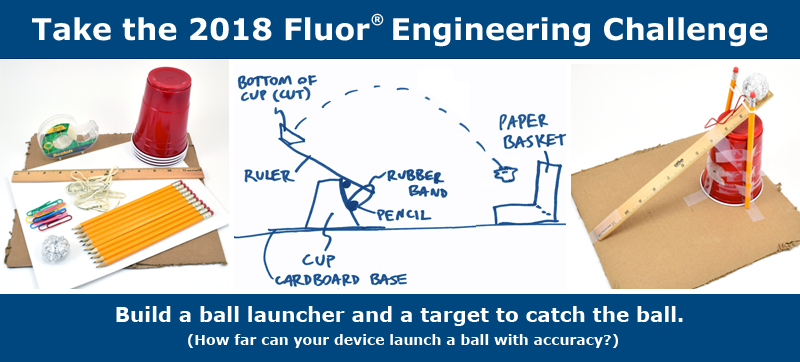
Enter the 2018 Fluor Engineering Challenge for K-12 Students (from the website)

Who can enter? The 2018 Fluor Engineering Challenge is open to K-12 students around the world. Students can enter individually or as teams of up to four students. Only one entry per team is allowed. 

What do I do? Build a device to launch a ball as far as possible, and another device to catch it, all from a limited list of materials like pencils, rubber bands, paper, and tape. The farther you can launch the ball (following the challenge rules) before it touches the ground, and the fewer materials you use, the higher your score. 

Where is the challenge happening? Students can do this challenge anywhere! The 2018 Fluor Engineering Challenge is designed as a fun hands-on engineering project to do at home, in the classroom, or as part of an afterschool program.

When is the challenge taking place? Students may build and test their ball launchers anytime now through March 16, 2018. Entries may be submitted February 18, 2018 through March 16, 2018. All entries are due by midnight Pacific Time (GMT-8) on March 16, 2018.

Why should I enter? Building devices to send aluminum foil balls flying across the room is fun! Plus, there are bragging rights up for grabs. We will be posting top scores on our 2018 Fluor Engineering Challenge score board. Students from anywhere in the world, regardless of location, are eligible to participate in the competition to get their team name on the score board by completing the challenge and submitting their scores. 

Additionally, Fluor will reward ten teams, drawn at random from the geographic locations listed below, with a $1,000 USD check for their school or afterschool program! 

List of Supplies (from Science Buddies Website):

Construction Materials
ItemMaximum
Quantity
Point cost (each)
Corrugated cardboard base (max size 12"x12" or 30x30 cm)10
Large paper or plastic cups (16–18 oz, or about 450–500 mL)450
Wooden ruler or paint stirrer (12"/30 cm)2100
Paper (printer/copier paper, not construction paper or cardstock; letter or A4 size)1010
Wooden pencils (circular or hexagonal cross-section, approx. 7–8" or 18–20 cm length)1010
Rubber bands (size 32, 3" long unstretched and 1/8" wide)1020
Large paper clips (approx. 2" or 50 mm length)105
Roll of clear adhesive tape (Scotch® tape or equivalent, 1/2" or 3/4" width, max length 500")1100


Here are some pictures from our 6th graders. Enjoy!


There were even more variations, but my phone battery ran out.  Too bad.

Isn't it amazing? The students were so creative! I did this project with the 6th graders because of the Fluor Engineering Challenge, but this is a great project on its own. The kids had a great time and learned even more in the process. I hope you try it with your children/students.

Have a wonderful day.

For your convenience, here is the previous blog post on the Fluor Engineering Challenge.


The best part? You still have time to enter? So, why don't you give it a try?


Monday, January 29, 2018

Take the 2018 Fluor Engineering Challenge!

I became aware of this competition a little over a year ago (2017 challenge, which was different from this one) when I was perusing the sciencebuddies.com site. I thought it was interesting and tried it with my daughter's class along with a few other classes.

Though the teachers and I were concerned about spilling water in class on the carpet (yes, last year's project involved a tub of water), it wasn’t too bad. And the project was great! The students learned a lot, but more importantly, they had fun figuring things out for themselves.

Year after year, this Flour Engineering Challenge is just plain fun. But best of all, it gives your children opportunities to win money for their school.

2018 Fluor Engineering Challenge


The objective of the 2018 Fluor Engineering Challenge is to use limited materials to build one device (the launcher) that launches an aluminum foil ball and another device (the receiver) that catches the ball. The farther your ball flies before being successfully caught by the receiver, the more points you get. 

Your children can use only a limited list of materials, and there are points associated with each item. The less material your children use, the more points they keep.

List of Materials (see website for more detail description):
Corrugated cardboard base
Large paper or plastic cups
Wooden rulers
Paper
Wooden pencils
Rubber bands
Large paper clips
Roll of adhesive tape

2018 Flour Engineering Challenge Website

Challenge objective & info

In mid-February, I’m planning to do this project at a local elementary school. I’ll share the results with you afterwards.


Have fun!