Wednesday, June 24, 2015

Awesome Books - The Year of the Horse, Tales from the Chinese Zodiac By Oliver Chin

I'm quite interested in Asian-American literature, especially for children, and I was very happy to come across this one.

My son took a free graphic novel class at the local library recently, and I bought this book from his instructor.


The title misled me somewhat in that I expected a more traditional tale of Chinese Zodiac focusing on the Horse. But it's not. 

It's about a boy named Tom and a filly named Hannah who are trying to figure out what their place on the farm is and what they'll be when they grow up. What I love about this books isn't what I thought I'd love - the Asian -American aspect of it. What I love about this books is that all the animals have their place on the farm, and they are happy and proud of what they contribute. 

But wait! There is a problem. 

A royal messenger (a rooster) brought a "request" from the Governor, and he is asking for a painting from Lao Shi. But she is old, and she can't take it to him herself. Quickly, Tom volunteers to help, and they set off to find someone to go with him.

After an extensive search, they think Hannah might be the perfect candidate for this trip. Before they go on this adventure, they practice working together by listening and learning from one another. 

Finally, Lao Shi finishes her painting, and Tom and Hannah are off to deliver the painting. On their journey, they leap over a snake, tiptoe past a sleeping tiger, and kept themselves dry in a cave during a rainstorm while a dragon circled in the sky.

When they arrive at the capital and deliver the painting, Tom and Hannah are treated to a wonderful dinner. But they want to come back home quickly; they miss their families. 

They enjoy their return trip, and when they arrive, everyone is happy to see them. Tom and Hannah continue to play together, but they also remember a very important lesson. 

They learned that they could "blaze their own trail."

So, I hope the children who read this book will be inspired to blaze their own trails.

P.S. - There are twelve animals in the Chinese Zodiac, and there are other books written by the same author. Others are just as whimsical and fun to read.


Monday, June 15, 2015

Awesome Books - Help Your Kids with Computer Coding by DK Books

Help Your Kids with Computer Coding


There are four books in this series I saw at Costco, and I had planned to feature them all together. But as I read through them more thoroughly, I realized that each of them is worthy of its own post. So, here I am starting with this one.

I've heard a lot about coding, and when I saw it at Costco while back, I thought I'd pick it up. I don't know much about coding, and I thought this might be a good book for all of us (my daughter and me) to get started.

One thing I REALLY like about this book is that it seems so friendly. Technical books can be quite intimidating, yet this one is quite friendly with a lot of graphics and explanations. As I said, I don't know much about coding, so this was a good fit for me. But if you know a little more, I'm not sure how you'd feel about this book. You might think it's too easy.

This book is broken into roughly four sections. 

The first section is about Scratch (an MIT developed coding language).


My daughter and I worked on installing it and working on a project together last year when she was in 2nd grade. Sure, we had our share of glitches (typos for small fingers), but it was fairly painless to follow the book & program something to see it work.

The second section is about Python. Python is a text-based programming language (the type I'm familiar with). Dare I date myself and tell you that my first computer language was...Fortran?


OK. I haven't coded in Python, yet, but one thing I love about this book is that it gives you equivalent commands in both Python (left hand light blue column) and Scratch (right hand more colorful column). So, if you've coded with Scratch already, it would be easier for you to understand what you're doing in Python (theoretically speaking).


This third section is a brief introduction to what's inside a computer.


The last section is about programming in the real world.


I bought this book from Costco for $11.95 last year, but a couple of weeks ago, when I went to Costco, I saw it there, again. So, if you have a Costco in your neighborhood (and who doesn't), you might want to pick one up. It's a great deal at the sticker price of $19.95 (especially when you think about how much you have to pay for a week of programming classes).

Enjoy!

Thursday, June 11, 2015

Fantastic Movies - On the way to School, A documentary by Pascal Plisson


My kids and I walk to school, almost every day unless it's raining or really hot. Our walk to school takes about ten minutes on a nice, paved sidewalk. So, when I came across this documentary on Netflix, I watched it and wow was all I could say.

At the end of the movie, I realized that these children might be living fuller lives (not easier) than my children. I realized that I need to allow my children to take on more than what my husband and I have given them so far.

I don't know what the intention of the movie was - to generate sympathy? Or to educate us? Well, it succeeded in doing both very well. But what I came away with is that I need to allow my children even more freedom and the responsibility that goes with it. 

~~~~~Spoiler Alert~~~~~

The movie opens with 11-year-old Jackson digging a hole in Kenya. Though I don't know how long he's been digging that hole, he finally gets what he wants, water. Water to wash his school clothes and water to take with him on his way to school.

Jackson and his younger sister must make a nine-mile journey that takes two hours to go to school. They make this trip twice a day, and must leave their house by 5:30 am in the morning to get to school by 7:30 am. 

The walk alone would be challenging enough, but they must make their journey through the elephant habitat, which can be very dangerous. There is a scene where Jackson and his younger sister are standing on a hillside, looking down at a herd of elephants. They talk about which route to take because of the elephants. Each day, their route to school will be slightly different because of the elephants. 

During their journey, the siblings each carry a book bag (?), a long, strong-looking stick, and a plastic jug of water. There is a scene where the sibling is hiding from the elephants, and the younger sister looks genuinely scared, and Jackson tells her to quiet her breathing because it might alert the elephants.

But they do arrive at the school safely, and Jackson leads the school in a flag-raising ceremony.


In Morocco, Zahira and her grandmother talk about the importance of school. Her grandmother never had a chance to attend school, and she reminds Zahira it's an opportunity she never had. 

Zahira and her two friends must trek through the Atlas Mountains, about 13 1/2 mile journey, twice a week to go to school. Fortunately, the girls stay in the dorms during the week and make the trek back home on Friday. This journey, to and from school, takes four hours, and the girls must rely on the kindness of random strangers for a ride on their vehicles for the a part of their journey to school.

What I found amazing is Zahira is carrying a live chicken (in a bag) along with a backpack full of books. When one of her friends hurt her foot (ill-fitting shoes, perhaps?), the three girls take a bit of rest. They try to hitch a ride on a donkey, but the man with the donkeys refuse to take them on his donkey. Though it sounds rather callous, his donkeys were laden with things, and I could understand why he might not want to tire his donkeys too much.

When they finally reach one of the bigger villages, they sit by the roadside to hitch a ride to school. They talk about how being later than usual means it's going to be harder to find a car that goes their way. Some time later, a truck full of goats come by, and the driver finally lets the girls hop on in the back, with the goats. On this final leg of their journey, the driver stops for prayers, and they continue. 

Zahira barters some fruits and vegetables for the chicken she carried, and the three girls are finally off to school.


In India, Samuel's two younger brothers push him through two miles of rough country roads, crossing streams and overcoming a flat tire, to get to school every day. The three brothers make this three twice a day, every day, and it takes them 75 minutes each way.

Samuel is a 13-year-old boy who looks pretty big and heavy compared to his two younger brothers who must push him to school. When stuck in a stream, the two younger brothers argue about picking the muddy route, etc., but the minute Samuel, the older brother, tells them to stop fighting and get going, they do.  When they get stopped on the road by a broken down truck, the men carry the wheelchair for the boys to get across. When they get a flat tire; a bicycle repair shop owner repairs it for them.

It's quite painful to watch their journey to school, with all the rutted roads, streams, etc., but never once did the two younger brothers seem to resent Samuel or the task they must perform. It was something they did every day. Not only that, when they reach Samuel's school, the youngest brother straightens Samuel's shirt collar and pats his face with so much affection and love that it's awe-inspiring and heartbreaking at the same time.

At the end, Samuel explains that he is extremely lucky for many reasons. There is a very smart girl whose rich family refuses to send her to school. He is aware of the fact that most kids like him, who can't walk, are kept at home and don't get to see the outside world much. He wants to grow up to be a doctor so that he can help others like him.


In Argentina, Carlito (11 years-old) and his younger sister ride a horse through the beautiful Patagonian landscape to get to school. This trip takes 1 1/2 hours, and they cover 11 miles. Though the landscape is beautiful, they must trek down a steep hillside and ride through rocky patches of land. 

I was worried that the horse might fall, and kids might get hurt, but Carlito manages very well with his younger sister happily chatting behind him.

A friend of mine runs a great non-profit organization (AsanteAfrica.org), and she invited a Masai warrior from Kenya to speak at her fundraising events in the USA. When he came, he stayed with her in the bay area, and he was startled by how little responsibility we, Americans, gave our children. He said he couldn't believe American mothers were fretting about their older children crossing the street when five or six-year-old Masai boys are expected to herd goats and keep them safe. 

When I was watching this movie, I was worried about Jackson and his younger sister getting to school safely. How could his parents bear not knowing if they arrived safely or not with the elephants roaming around? 

I was amazed by Zahira and her friends making the trek over the Atla Mountains but was horrified by the thought of something happening to them. Who knew what or who lurked in those narrow, steep mountain paths? And to hitchhike their way to school? Get into any random car that stopped to pick them up? Who knew what kind of person was driving the vehicle. What if...?

I was inspired by Samuel and his brothers, but I was doubly impressed by their parents. They were poor, yet they were so rich in many ways. They've instilled love and responsibility in those younger brothers but kept Samuel's dreams alive. Would my children be able to do that? Would they want to do that every day? Twice a day? Would I be able to keep my children's dreams alive under the most trying circumstances?

If I had to choose one life to live among the four, I would choose Carlito's life. He and his family seemed to live in the modern world, but in a rural setting that allowed them to live the life they wanted to live. Carlito said he wanted to live just like his parents, and I don't blame him. Next year, he'll be going off to a boarding school, and his younger sister (~seven or eight-years-old?) would have to ride the horse by herself to go to school. Would I be able to do that with my little girl? For 90 minute horseback ride to school over the steep terrain?

This documentary stayed with me far longer than I expected. It made me think about what I want my children to have in their "tool box" of abilities when they go out into the world.


Monday, June 1, 2015

Roaring Roller Coasters - June 1 , 2015

I decided to do a roller coaster project because, for the last two years, this was the team building project for the Tech Challenge teams at the Tech Museum of San Jose. So, I thought it must offer a lot of different learning opportunities, and it did.

The point of this project is NOT to find a right answer (because there is no right answer) but to encourage the team-building skills and problem-solving skills. I didn't realize that when I started, but it soon became clear.

But I do start the project, I ask the class about if any of the students have a favorite roller coaster, then we talk about some of their favorite roller coasters. Then I talk about potential energy and kinetic energy - the definitions, examples, formulas, drawings, etc. 

Potential Energy = mgh (m-mass, g-gravity, h-height)

Kinetic Energy =1/2mv2 (m-mass, v-velocity/speed)

A higher object has a greater potential energy (given the same mass), and a heavier object has a greater potential energy (given the same height), too. As the roller coaster drops from the high point, all of its potential energy is converted to kinetic energy, making the roller coaster to go fast.

Supplies List:

  • A length of 1/2" pipe insulation 
  • Three types of 1/2" balls or roller coasters (wooden - empty roller coaster, glass - half-filled roller coaster & metal bearings - full roller coaster)
  • Some kind of materials to make support structures (I recycled strips of corrugated plastic boards we used for the Tech Challenge competition), but straws, chopsticks, foam/plastic cuts, etc. will do just fine
  • Scotch tape
  • Masking tape
  • Cup (foam or plastic), but not too large

The goal of the project is to create a very exciting roller coaster for all three types of roller coaster types.

Project Requirement:

  1. All three types of roller coasters (must roll, jump, fall, etc. into a cup in the same location.
  2. Roller coaster design must have a loop, spiral or something to make the ride exciting.
  3. The cup cannot touch the roller coaster track (1/2" pipe insulation).
  4. Any team members cannot hold the track in place. The track must be standing on its own.
  5. There is no winning criteria except that it must offer an exciting ride.


Building Instructions:

  1. Test different designs by holding the track and rolling different types of balls down the track.
  2. Once the team decides on the design, build the support structure to hold the track in place.
  3. But first, tape the top of the roller coaster against something solid - wall, desk, chair, backpack, anything, then start putting in loops, spirals, etc. Trying to secure the complete roller coaster all at the same time is the most difficult way to go.
  4. Brain-storm, design, test, and repeat.


Again, the possibilities are endless. Have fun!

Monday, May 4, 2015

Tech Challenge 2015 Update - May 4, 2015

It was a crazy weekend.

We arrived at the Tech Museum ~9:20am on Sunday (4/26), but we didn't get through the competition until 11:30am! I don't know why the progress was so slow, especially when the Tech Challenge organization got rid of the Design Journal Interview section. I guess the success of the program caught up with the organization, and that's a good news. I hate to think what it'll be like next year, but I hope more kids will join the competition.

Either way, my team finished well, but more importantly, they had a lot of fun. They danced, they laughed, and they had fun with their team. I hope you and your kids will join us next year.

Preparing for the competition in the Pit

Getting the structure weighed

Participation medals

Getting ready for the interview


Getting in line for the structural performance/device testing

Setting up the structure on the shake table


End of competition interview


Award ceremony


Thursday, April 30, 2015

Fantastic Flight! - April 30, 2015

This is a project I do with the students, 1st grade to 6th grade, every year because they love it. And I love it, too. Why? This project is full of opportunities for creativity and experimentation. Possibilities are endless!

The motto for this project is - Fail Spectacularly! I ask the students to push the envelope and come up with something very different from others. I challenge them, and every year, they meet the challenge in spades.

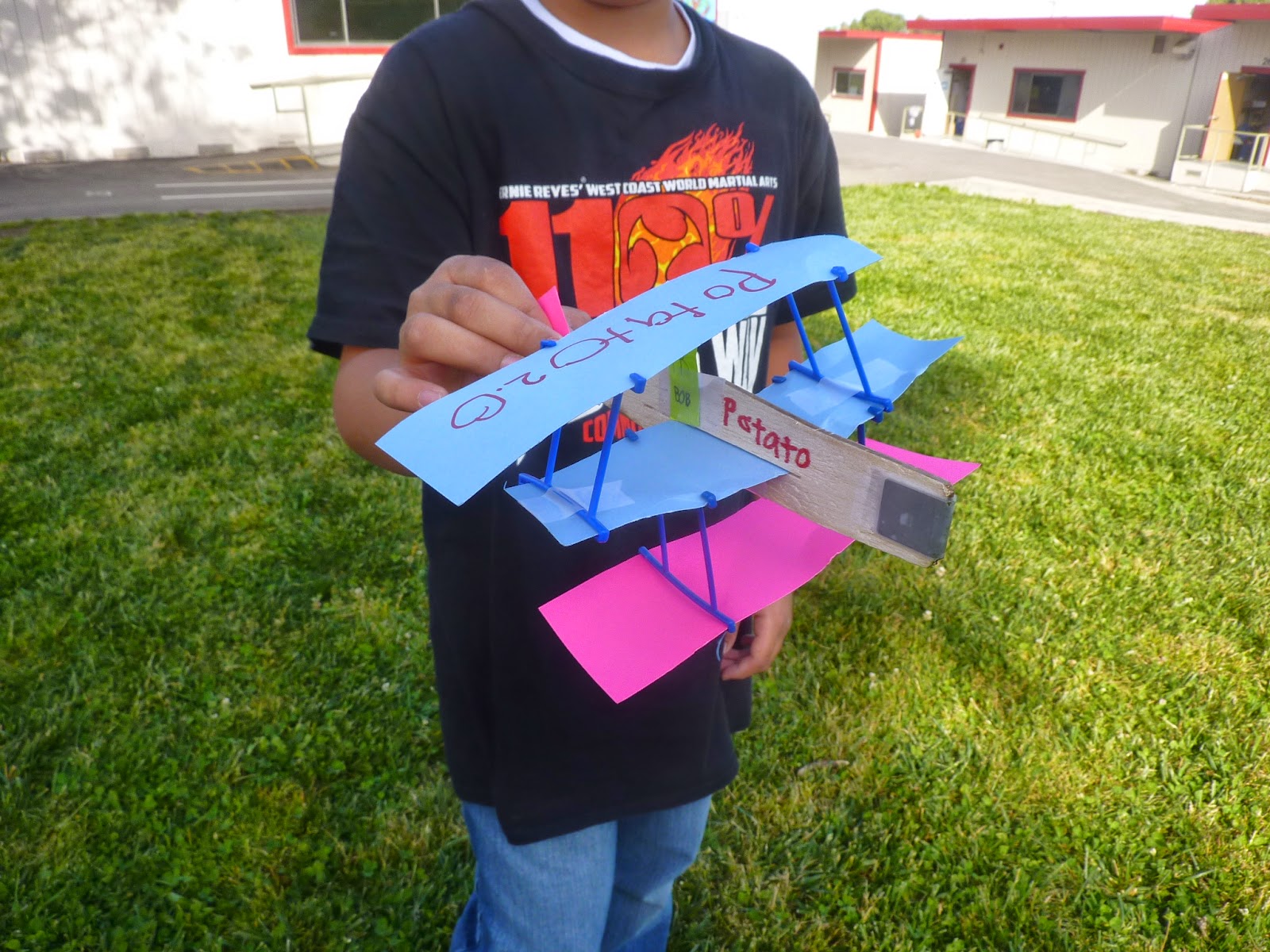
I get the gliders from the nearby hobby store, Sheldon's Hobbies, and I get them at a discount, which helps me keep the costs down. I usually buy single wing plane, but in the last couple of years, I've bought bi-planes. These are a little more complicated, but it's also more interesting to mix up the kits a bit.

A warning, though. These glider kits are rather fragile. One student broke the wing in four different places. So, I usually start off by telling them to be extra careful, and in lower grades, I show them how I shimmy the wing into the glider body.

Supplies List:
  • Wooden glider kit (1 kit/student)
  • Cardstock (2 sheets/student)
  • Scotch Tape
Building Instructions:
  1. Hand out the glider kit and tell the students to put it together by following instructions (I show the 1st and 2nd graders how to put them together).
  2. Go fly the glider outside and tell the students to watch how it flies through the air. Allow the students to fly the gliders several times.
  3.  Once back in the class, tell the students to take the gliders apart. The only part they can use for the next phase of the project is the body.
  4. Hand out a sheet of cardstock paper to each student. 
  5. Tell the students to make new parts with cardstock paper. There's only one rule - the new glider parts must be a different shape and size from the original wooden parts.
  6. Encourage the students to fly their new gliders and make improvements.
  7. About 2/3 way through the class time, hand out another piece of cardstock paper and ask them to design another glider, preferably a very different design from the first glider.
  8. Again, encourage them to fly the gliders and make improvements throughout. I've learned over the years that students don't need more than a piece of cardstock paper to make all the parts. 
  9. I usually have two different contests - distance flier and trick flier. Here's the secret. It doesn't matter whether their gliders fly far or do tricks. What I'm trying to encourage is creativity, problem-solving skills, and perseverance.
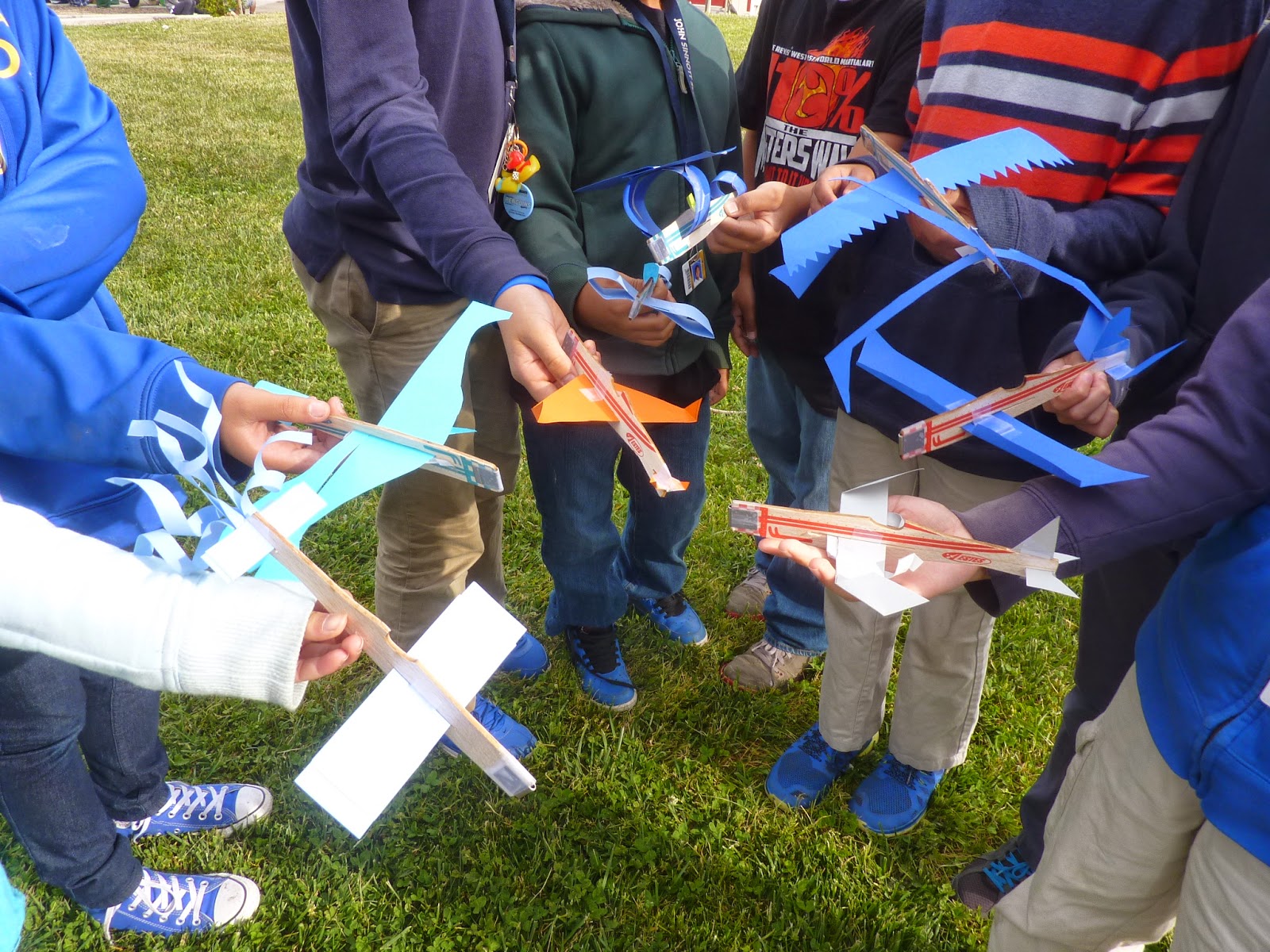
Here are pictures of the gliders I've used in the past & what the biplane glider looks like:


There are a lot of pictures here. I thought about take some of them out, but I thought I'd give you the choice of checking it out or not. 

Some pictures from a couple of 3rd grade classes:


Some pictures from a couple of 4th and 5th grade classes:


As you can see, the possibilities are endless. It's amazing how much fun you can have with children with a glider kit and some cardstock paper.

Have fun!